
How to Decode Your Food: A Step-by-Step Guide to Reading Labels
Walking down the aisles of an Indian supermarket, you’re bombarded with labels promising “healthy,” “natural,” and “low-fat.” But the truth about what’s inside is often very different from its marketing. Learning to read a food label is a simple skill that can profoundly impact your health. It’s about looking past the shiny exterior and understanding the facts.
This guide will walk you through the three most important parts of a food label—using real Indian products as case studies—and reveal how misleading marketing can be.
Step 1: Ignore the Front of the Package
The front is a marketing billboard. Claims like “High in Fiber”, “Fortified with Vitamins”, or “No Added Preservatives” are designed to distract you from the real story on the back.
Case Study: Mango Drinks (Slice, Frooti, Tropicana)
The packaging shows juicy mangoes, suggesting a wholesome, fruity drink. But turn the bottle around, and you’ll see this typical ingredients list:
- Water
- Sugar (or High-Fructose Corn Syrup)
- Mango Pulp/Concentrate
- Flavouring Agents
- Acidity Regulators
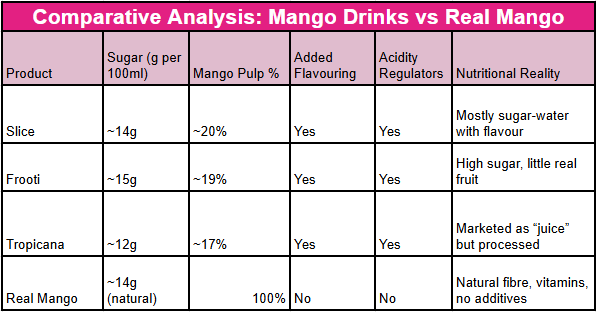
Here, sugar is the second ingredient—meaning you’re essentially drinking sugar water with a little mango flavor.
📌 Fact: According to a 2021 Centre for Science and Environment (CSE) study, most packaged fruit drinks in India contained less than 20% fruit pulp, despite strong “fruit” branding. Here is a comparative analysis of the “so called natural mango drink” ingredients
Step 2: Read the Ingredients List
Ingredients are listed in descending order by weight. So the first two ingredients usually make up most of what you’re eating.
Case Study: Breakfast Cereals
Many “healthy” cereals marketed for kids (like Chocos or Honey Loops) have sugar listed in the top 3 ingredients. Even “multigrain” or “fortified” cereals often contain 30–40% sugar by weight.
📌 Fact: A 2019 Public Health Foundation of India (PHFI) review found that 85% of packaged foods in India were “high in sugar, salt, or fat” as per WHO standards.
Case Study: Digestive Biscuits
A popular “digestive” biscuit proudly advertises fiber. But the first ingredients are refined flour and sugar. The “fiber” comes in much later on the list—making it more of a marketing gimmick than a nutrition boost.
Step 3: Understand the Nutrition Table
This is where the truth lies. Here’s how two common biscuit types compare (per 100g):
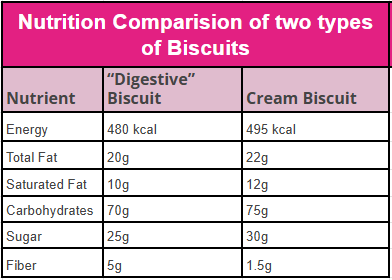
The “digestive” has slightly less sugar and more fiber, but nutritionally, both are highly processed foods with little difference in calories, fat, or sugar load.
📌 Fact: The Food Safety and Standards Authority of India (FSSAI) has acknowledged this issue and in 2022 proposed “front-of-pack nutrition labeling” to warn consumers when a product is high in sugar, salt, or fat.
What to Look For
- Serving Size – Labels often trick you with tiny serving sizes. A “200 ml pack” of juice may actually contain 2 servings on the label.
- Sugars – Compare to WHO’s recommendation: less than 25g/day (≈6 tsp) for optimal health.
- Fats – Watch especially for trans fats, which should be zero.
- Hidden Sugars – Look for aliases: sucrose, glucose, fructose, dextrose, HFCS, malt extract, fruit juice concentrate, honey.
📌 Fact: A 2018 study in BMJ Open on Indian packaged foods found 67% of products used multiple sugar sources to disguise the true sugar content.
Extra Case Studies in Indian Context
- Packaged Juices vs Fresh Juice
A 200 ml packaged juice box can have 20–25g sugar—nearly your entire day’s limit. Fresh juice from the fruit itself has natural sugars but also more fiber if consumed whole. - “Low-Fat” Namkeens & Chips
Products labeled “baked” or “low-fat” often have the same salt levels as fried chips. High sodium intake in India is linked to 1.6 million deaths annually (ICMR-India State-Level Disease Burden Report, 2017). - Energy Drinks
Popular brands in India often have 30–35g sugar per can—more than a cola. They also contain high caffeine levels, which can worsen dehydration and heart risk.
Final Word
By mastering these three steps—ignoring the front, reading the ingredients list, and checking the nutrition table—you’ll cut through marketing noise and take control of your health.
Food companies want you to buy with your eyes. But informed consumers look at the back of the pack. In India, where obesity and diabetes rates are soaring (India has 101 million diabetics as of 2023, IDF), this simple habit can be a game-changer.
References:
- PHFI & ICMR: Packaged food nutrient profile, 2019
- CSE (Centre for Science and Environment): Fruit drink analysis, 2021
- FSSAI: Draft regulation on front-of-pack labeling, 2022
- IDF: Diabetes Atlas, 2023
- BMJ Open, 2018: Sugar in Indian packaged foods